
Quantum fast-forwarding fermion-boson interactions via the polaron transform
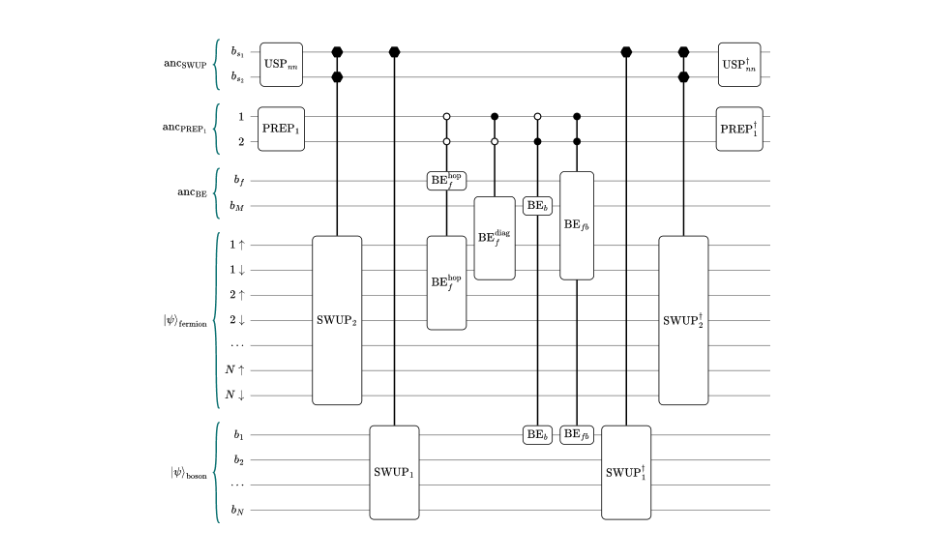
Simulating interactions between fermions and bosons is central to understanding correlated phenomena, yet these systems are inherently difficult to treat classically. Previous quantum algorithms for fermion-boson models exhibit computation costs that scale polynomially with the bosonic truncation parameter, Λ. In this work we identify the efficient unitary transformation enabling fast-forwarded evolution of the fermion-boson interaction term, yielding an interaction-picture based simulation algorithm with complexity polylogarithmic in Λ. We apply this transformation to explicitly construct an efficient quantum algorithm for the Hubbard-Holstein model and discuss its generalisation to other fermion-boson interacting models. This approach yields an important asymptotic improvement in the dependence on the bosonic cutoff and establishes that, for certain models, fermion-boson interactions can be simulated with resources comparable to those required for purely fermionic systems.

Faster Quantum Chemistry Simulations on a Quantum Computer with Improved Tensor Factorization and Active Volume Compilation
In this work, we combine several advances to electronic structure calculation for molecular systems, resulting in a 2-orders-of-magnitude speedup of estimated runtimes over prior-art algorithms run on comparable quantum devices…

Resource-optimized fault-tolerant simulation of the Fermi-Hubbard model and high-temperature superconductor models
Exploring low-cost applications is paramount to creating value in early fault-tolerant quantum computers. Here, we optimize both gate and qubit counts of recent algorithms for simulating the Fermi-Hubbard model…

End-to-end framework for simulating the time evolution of a chemical reaction on a fault-tolerant quantum computer
Researchers from PsiQuantum and Stanford have developed a comprehensive state-of-the-art end-to-end framework for the simulation of real-time dynamics of chemical systems on a fault-tolerant quantum computer; this is of interest in modeling the dynamics of chemical reactions, such as those that involve catalysts.

PsiQuantum and Boehringer Ingelheim: Fault-tolerant quantum computation of molecular observables
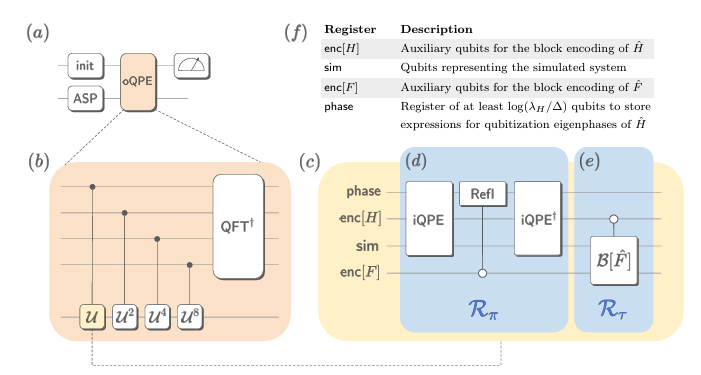
Over the past three decades significant reductions have been made to the cost of estimating ground-state energies of molecular Hamiltonians with quantum computers. However, comparatively little attention has been paid to estimating the expectation values of other observables with respect to said ground states, which is important for many industrial applications.

PsiQuantum and Mercedes-Benz: counting qubits for better batteries
The widespread adoption of electric vehicles rests on developing faster charging, longer lasting battery technology – the critical enabler for transitioning away from internal combustion engines. PsiQuantum has been working with Mercedes Benz to assess just how advanced a quantum computer must be to revolutionize Lithium-ion (Li-ion) battery design.

A variational eigenvalue solver on a photonic quantum processor
Quantum computers promise to efficiently solve important problems that are intractable on a conventional computer. For quantum systems, where the physical dimension grows exponentially, finding the eigenvalues of certain operators is one such intractable problem and remains a fundamental challenge.
Author: Peruzzo et al. Nat Commun 5, 4213 - Published: Jun 23, 2014
All authors: Alberto Peruzzo, Jarrod McClean, Peter Shadbolt, Man-Hong Yung, Xiao-Qi Zhou, Peter J. Love, Alán Aspuru-Guzik, Jeremy L. O’Brien