
RLEASE: Learning Where the Hard Chemistry Lives
Every powerful scientific tool has a targeting problem.
Before using the most expensive microscope, you choose where to look. Before running the most detailed simulation, you choose which part of the system deserves that level of detail. And before a future fault-tolerant quantum computer can deliver value in chemistry, scientists need to answer a deceptively hard question:
Where, inside a molecule, does the hard chemistry actually live?
In quantum chemistry, this question often becomes the problem of active-space selection.
The active space is the subset of molecular orbitals where the most important electron correlation lives. These are the orbitals that define the hard part of the chemistry: bond breaking, transition-metal behavior, diradicals, excited states, catalytic intermediates, and other regimes where a single electronic configuration is not enough. Choose the active space too small, and the calculation can miss the essential physics. Choose it too large, and the cost can become impractical.
For decades, active-space selection has required expert judgment. A computational chemist inspects the molecule, runs diagnostics, looks at orbitals, adjusts the selection, tests again, and iterates. That expert loop can work for carefully studied systems. It does not naturally scale to high-throughput screening, molecular dynamics, reaction pathways, or future quantum-computing pipelines where many related calculations need to be prepared systematically.
That is the bottleneck RLEASE addresses.
RLEASE was developed by PsiQuantum’s dedicated team of computational chemists and quantum algorithms researchers, who are building the software and methodology layer needed to connect high-fidelity solvers to real chemistry workflows.
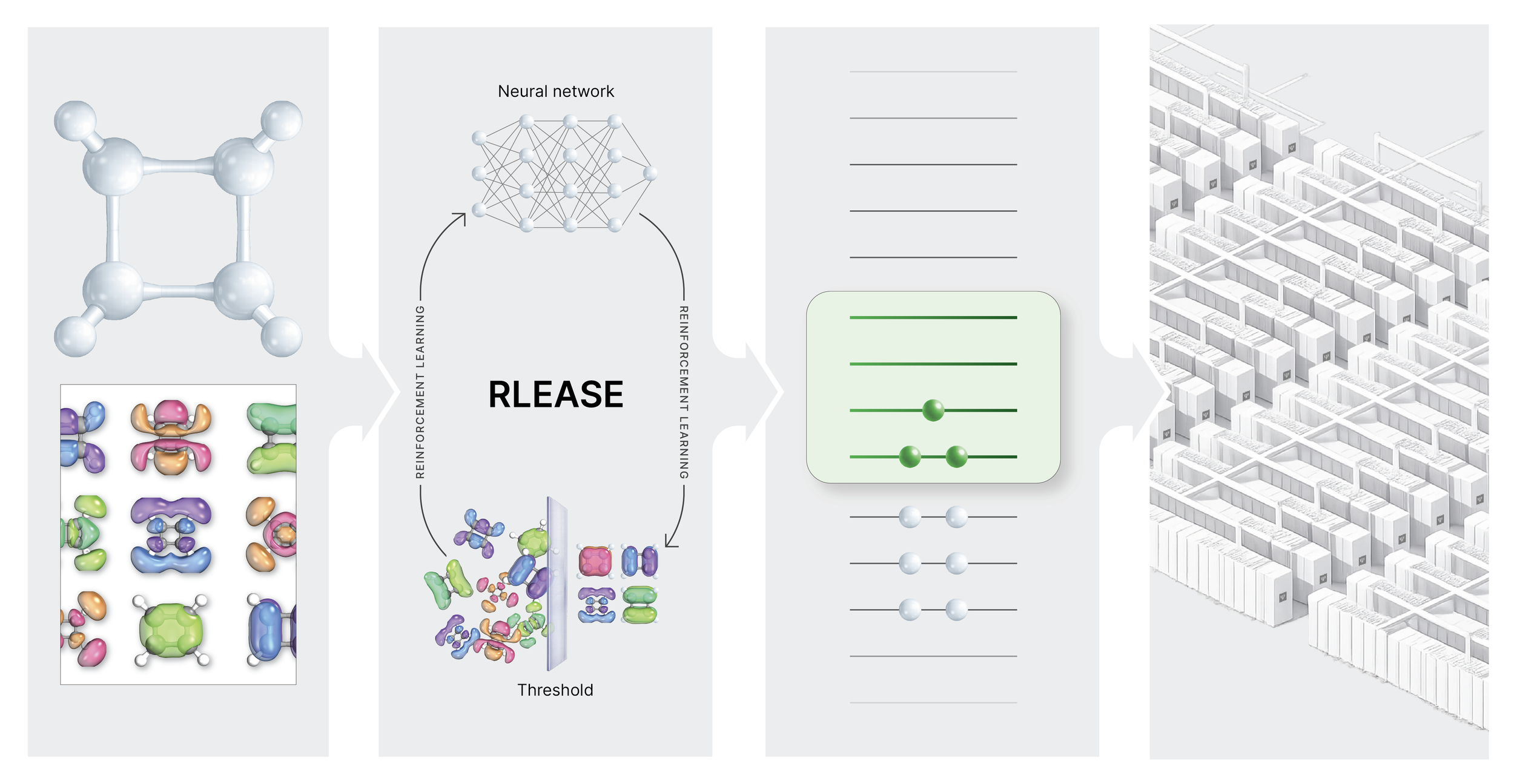
RLEASE — Reinforcement Learning Efficient Active Space Engine — is a new method from PsiQuantum that teaches an AI system to identify compact, chemically meaningful active spaces. Instead of relying on molecule-specific trial-and-error or expensive pilot calculations at deployment time, RLEASE learns from inexpensive molecular information and uses reinforcement learning to decide which orbitals should receive high-fidelity treatment.
The broader idea is simple: Use cheap signals to decide where expensive accuracy should be focused.
RLEASE starts from a relatively inexpensive Hartree–Fock calculation. From that starting point, it builds compact descriptors for each orbital — numerical summaries of properties such as energy, spatial character, bonding character, occupation, and atomic-orbital composition. A neural network predicts which orbitals are likely to be important. A reinforcement-learning policy then learns how to turn those predictions into an active space.
RLEASE is trained against energy accuracy, not just visual intuition or a fixed rule. During training, candidate active spaces are tested against high-accuracy classical reference data. The system learns which selections actually improve the downstream calculation.
That makes RLEASE different from approaches that treat active-space selection as a detached preprocessing step. It does not only ask, “Which orbitals look important?” It asks, “Which selected subproblem actually improves the calculation?”
Another practical advantage is cost. Some automated active-space methods require an expensive pilot calculation on the target system before they can choose the active space. RLEASE avoids that step at deployment. Once trained, it can use inexpensive orbital descriptors and neural-network inference to select active spaces for new geometries.
If active-space selection remains an expert craft, it becomes a bottleneck for every larger workflow built on top of high-fidelity quantum chemistry. If active-space selection becomes automated, transferable, and energy-aware, it becomes a routing layer: a way to decide where high fidelity matters.
The paper’s results are encouraging. RLEASE was trained on only three molecules — Na₂, ClF, and SiO₂ — sampled across geometries. It was then deployed without retraining to a broader set of systems, including main-group molecules, open-shell radicals, and transition-metal hydrides. That is a deliberately difficult transfer test: the goal is not to memorize a few molecules, but to learn a portable signal for orbital importance.
In one benchmark, RLEASE roughly halves the error of a standard automated selector for a multireference workflow: 0.120 eV mean absolute error compared with 0.221 eV against high-accuracy reference energies. In another high-accuracy workflow, it essentially matches the automated reference selector — 0.103 eV vs. 0.101 eV — while avoiding the expensive pilot calculation required at inference.
One case study captures the intuition particularly well. The paper tests RLEASE on p-benzyne, a classic diradical molecule that challenges simpler electronic-structure methods. Without molecule-specific tuning, RLEASE selects a compact active space that includes the types of orbitals chemists would expect to matter: orbitals associated with both the π system and the radical centers. p-Benzyne was not in the training set. That is the point: RLEASE is not just memorizing examples; it is learning a transferable signal for where strong correlation lives.
For PsiQuantum, RLEASE is important because useful quantum computing will require more than hardware alone. A fault-tolerant quantum computer can provide a powerful high-accuracy solver for certain hard subproblems. But a workflow still needs to decide which subproblem to solve, how to define it, how to keep it compact, and how to connect the result back to a larger chemistry or materials question. Just as importantly, tools like RLEASE help us scout the landscape of quantum chemistry itself. They help identify which problems can be handled efficiently with classical high-fidelity solvers, which problems need better classical workflows, and which regimes are most likely to require future quantum hardware. That distinction is essential: the goal is not to send every hard-looking molecule to a quantum computer, but to learn where quantum hardware will matter most.
RLEASE addresses one piece of that larger challenge. It helps automate the construction of chemically meaningful active spaces. It reduces reliance on expert trial-and-error. It supports high-fidelity classical workflows today. And it helps prepare the kind of quantum-ready subproblems that future fault-tolerant quantum computers may solve tomorrow.
Rather than displacing quantum chemistry, AI enhances its scalability by helping identify where molecular complexity is concentrated. Classical high-fidelity solvers can act on that routing decision today. Looking ahead, fault-tolerant quantum computing is expected to become the highest-accuracy tier for selected hard cases, especially where complex electron correlation limits today’s classical methods.
RLEASE shows a broader principle for scalable quantum-enabled chemistry: do not spend high fidelity everywhere. Learn where the hard chemistry lives, route the right solver there, and use the result to improve the larger workflow. In doing so, RLEASE helps make today’s high-fidelity classical methods more scalable, helps prepare quantum-ready subproblems for future fault-tolerant quantum computers, and helps PsiQuantum understand where quantum hardware will matter most.
Before running the expensive calculation, RLEASE asks the question every scalable quantum chemistry workflow will need to answer: Where does the hard chemistry actually live? Increasingly, that answer can be learned.